Guide
Fan motor or compressor: telling two noises apart
Open the refrigerator door: if the noise stops the instant the door comes off its seal, it is an evaporator fan inside the cabinet, because a door switch cuts that fan the moment the door opens. If the noise carries on unchanged, it is coming from the machine compartment behind the grille, where the condenser fan and the compressors live. That single test splits most built-in noise complaints into two completely different repairs, one of them cheap and one of them not, and it takes about four seconds. Everything below is about what to do with the answer.
Five motors, and they are not in the same place
A built-in refrigerator has more moving parts than people expect, and they are grouped in two locations. Behind the grille, which on most built-in columns sits at the top of the cabinet, is the machine compartment: the condenser coil, the condenser fan that pulls air across it, and on a dual-refrigeration unit two compressors, one per sealed system. Inside the cabinet, out of sight behind an interior panel, each compartment has its own evaporator fan circulating air over its own coil. So on a dual-refrigeration cabinet there are typically five motors running at various times, two compressors, one condenser fan and an evaporator fan in each compartment, and they fail in different ways at wildly different prices. Sound alone is not enough to tell them apart in a kitchen with hard surfaces, because a built-in sits in joinery that reflects and carries noise. Location plus timing is what actually identifies the source, and both are things an owner can establish before making the call.
- Condenser fan: behind the grille, runs whenever a compressor runs
- Compressors: behind the grille, two of them on dual refrigeration
- Evaporator fans: inside the cabinet, one per compartment, stopped by the door switch
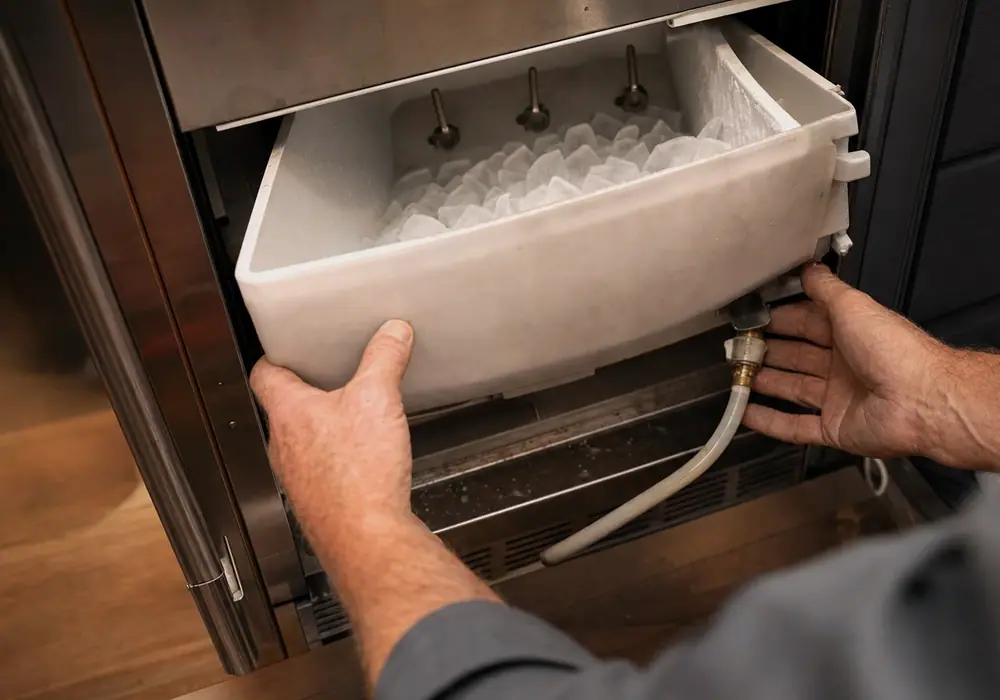
- Ice maker motor and water valve: intermittent, and neither one is a fault
Four tests worth doing before you pick up the phone
Do these while the noise is actually happening, which usually means waiting for the unit to cycle rather than chasing it. The door test comes first and settles the biggest question. Then kneel at the grille and listen there, then at the seam of the closed door, and note which position is louder; sound from the machine compartment is unmistakably louder at the grille. The third is the touch test. Rest a flat hand on the side of the cabinet, then on the surrounding cabinetry and the floor in front of it. A noise you can feel as much as hear, especially one that seems to come out of the woodwork rather than the appliance, is vibration being transmitted through mounts or through contact between the unit and the joinery, and that is a different conversation from a bearing. The fourth is timing, and it costs nothing to note: whether the sound is continuous, whether it starts and stops with the cooling, or whether it arrives in short bursts every few minutes, which is a different fault again.
- Door test: open the fresh-food door, then the freezer door, and note which noises stop
- Position test: listen at the grille and at the door seam, and note which is louder
- Touch test: feel the cabinet, the surrounding cabinetry and the floor for vibration
- Timing test: continuous, cycling with the cooling, or in bursts every few minutes
What a fan sounds like as it fails
Fan noise is rotational, and it tracks the speed of the blade, which gives it a steadier and higher-pitched character than anything the compressor does. Failures arrive in a fairly reliable order. First a rattle or a buzz, often intermittent and sometimes changing if the unit is nudged, which is debris caught in the blade or a blade touching a shroud. Then a whirring that coarsens into a growl as the bearing dries out. Then a whine that climbs week by week until the motor draws more current than it should and finally stops, at which point the noise complaint becomes a cooling complaint. An evaporator fan striking frost sounds different again, more of a chirp or a flutter, and it usually arrives alongside a defrost fault rather than by itself. On the ocean side of the 101 the bearings are the parts that go first, because salt air works on them long before anything else on the machine shows its age.
What a compressor sounds like, and the pattern that is not really noise
A running compressor is low, steady and more felt than heard, with a brief surge as it starts and a settled hum after that. Because it is bolted to the chassis on rubber mounts, its sound reaches you through the structure rather than the air, and when those mounts harden with age the hum passes into the cabinetry and comes out of a wall in another room, which is why owners so often describe it as coming from somewhere other than the kitchen. A genuine mechanical knock or metallic rattle from the compressor body is rare and is a serious finding. Far more common, and far more urgent, is a pattern that owners describe as clicking: a click, several seconds of humming, another click, repeating every few minutes while the compartment slowly warms. That is a compressor attempting to start and tripping out on its overload protector, which points at the start components or at the compressor itself, and it needs a meter rather than an ear.
- Low steady hum, felt through the floor and joinery: normal running compressor
- Hum that appears in the walls of the room: mounts hardened or cabinet contact
- Click, hum for a few seconds, click, repeating: a failing start, not a noise problem
- Knocking or metallic rattle from the compressor body: stop guessing and get it tested
The noises that are neither
Several sounds on a built-in are the machine working correctly, and they get reported as faults often enough to be worth naming. The water inlet valve buzzes for a few seconds once or twice an hour as the ice maker fills, and it is loud enough through a quiet kitchen at night to convince people something has failed. The ice maker harvest is a short motor whirr followed by cubes hitting the bin. A gurgle or trickle in the half hour after a defrost cycle is refrigerant settling and melt-water finding the drain. Popping and creaking from the interior liner is plastic expanding and contracting as the compartment cycles. None of those needs a technician. What does need one is any of them changing character: a valve that buzzes for far longer than it used to is a water supply problem rather than a noise problem, and a gurgle that never stops is not a defrost sound at all.
- Short buzz once or twice an hour: the water inlet valve filling the ice mold
- Whirr then cubes dropping: a normal ice harvest
- Gurgle or trickle after a defrost: refrigerant and melt-water, both expected
- Popping and creaking from inside: the liner changing temperature
What each answer costs, and which noises have a deadline
The prices are far apart, which is the whole reason for sorting the noise out before anyone is called. A condenser fan motor is an ordinary part fitted through the grille, and it is the repair with a genuine deadline attached, because a seized condenser fan stops both sealed systems shedding heat and turns a noise into two warm compartments and a compressor working against pressure it was never meant to see. An evaporator fan motor is a similar part behind more access, and if the coil is iced the visit includes clearing that first. Hardened mounts, or a cabinet touching the joinery it sits in, cost little or nothing to correct. A compressor is the expensive end, involving refrigerant recovery and a sealed system opened deliberately. Noise is the only fault on this equipment that gives you advance warning, so the useful rule is simple: a fan replaced while it is merely noisy is a scheduled visit, and the same fan replaced after it seizes comes with spoiled food attached.
Questions
Frequently asked questions
The noise stops when I open the door. Is that normal?
Normal, and deliberate: a door switch cuts the evaporator fan so the unit is not pushing cold air out of an open door. It tells you where the noise lives, not whether it is a problem. If that fan is rattling, whining or growling while it runs, it still needs attention. Call Encinitas Sub-Zero Experts on (858) 779-0698 and ask.
How long can I keep running the refrigerator with a noisy condenser fan?
Longer than you should, which is the trap. The unit goes on cooling while the bearing gets worse, so nothing forces the decision until the fan stops and both compartments warm together. By then the compressors have spent days or weeks running against heat they could not reject. A fan replaced while it is only noisy is one straightforward visit. Encinitas Sub-Zero Experts takes those calls on (858) 779-0698.
Is a humming compressor normal, or should a built-in be silent?
A low, steady hum you notice in a quiet kitchen is normal, and on a dual-refrigeration unit two compressors can run at different times. What is worth investigating is a hum that has changed: louder than it used to be, coming through the cabinetry or the wall, or accompanied by a knock or rattle. That is a two-minute call to Encinitas Sub-Zero Experts on (858) 779-0698.
Appliance down in Encinitas?
Tell us the brand and what it is doing — we can usually name the likely repair before we arrive.