Guide
Burner clicks and will not light: ignition, spark modules and caps
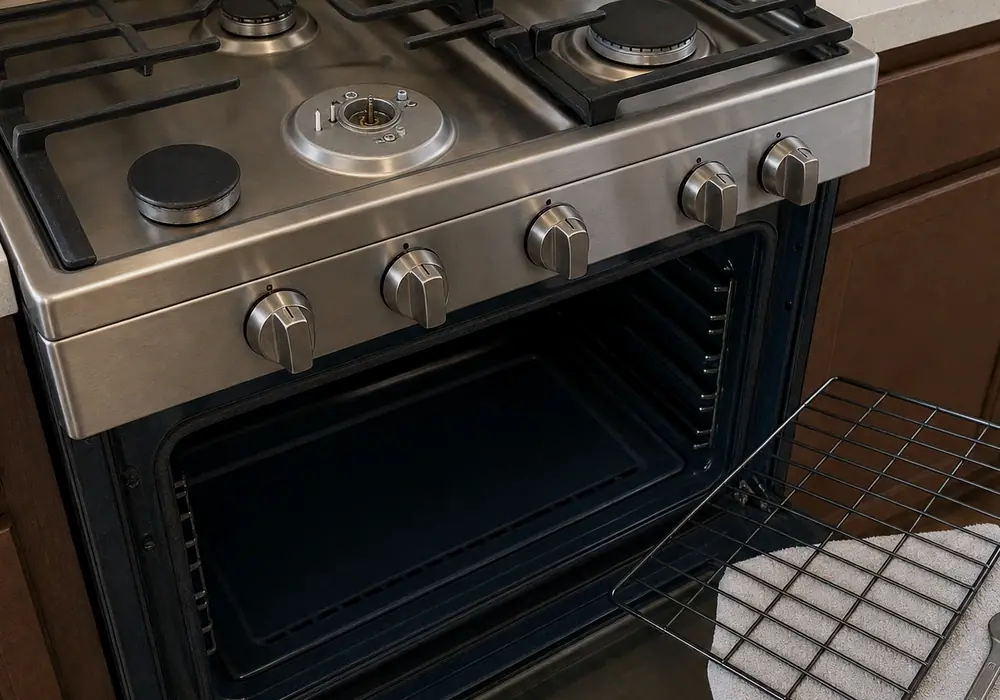
When a Wolf surface burner clicks and will not light, or clicks on and on after it has lit, the cause is usually sitting on top of the burner rather than inside the range. On a spark-ignition rangetop the electrode beside each burner does two jobs: it throws the spark that lights the gas, and it then senses the flame by passing a tiny current through it. If flame never reaches that electrode, the module keeps sparking, because as far as it knows the burner never lit. A cap seated a few millimeters out of position, or a ring of ports crusted with boil-over, produces exactly the same endless ticking as a failed part, and checking it costs nothing.
How the spark system works, and why it keeps clicking
Turning the knob opens the gas valve and closes a switch that wakes the ignition module. The module produces high-voltage pulses, each one jumping from the tip of a ceramic-insulated electrode to the grounded metal of the burner base, and that spark lights the gas at the ports. What happens next is the part owners rarely know about. Once the burner is alight the same electrode is used to prove the flame, by passing a very small current through the flame itself, and the module stops sparking only when it sees that current. This is a safety feature, not a nuisance: if a draft from an open window or a pot boiling over kills the flame, the module notices within a second or two and relights the burner instead of quietly filling the kitchen with gas. It also means that anything preventing flame from touching the electrode leaves the module sparking forever at a burner that is already lit.
- Ignition module: makes the high-voltage pulses and watches for flame
- Electrode: sparks the gas, then senses the flame it started
- Burner base and cap: shape the flame ring and carry it around to the electrode
- Valve and switch: gas and the module's start signal, opened by the same knob
One burner clicks and the others are fine
A fault confined to a single burner is confined to that burner's parts, which makes this the easy case. Let the top go completely cold, then lift the cap off and set it back on: it locates on the base in one correct position, and a cap that has been knocked askew during cleaning, or dropped back on rotated, is the most common single-burner complaint there is. With the cap off, look across the ring of ports with a flashlight for the ones packed with carbonized spillover. Look at the electrode too. The tip should be dry and clean, and the white ceramic sleeve around it should be intact, because a cracked sleeve lets the spark track to the nearest grounded metal instead of jumping the gap where the gas is. Two different faults hide inside the phrase will not light, and they separate cleanly: an audible spark with no flame is a gas or port problem, while a flame that lights and then keeps ticking is a sensing problem.
Every burner clicks at once, usually the day after something boiled over
Water is the usual culprit and it is worth ruling out before anything is called a failure. Liquid bridging the gap at one electrode, or sitting under one cap, can hold the module sparking, and on many rangetops a single pulse train fires more than one electrode, so one wet burner sets the entire top ticking. Turn every knob off, take the caps off, wipe underneath them and around each electrode, and leave the top alone for a few hours in a dry room. A fan pointed at it helps; a heat gun does not belong anywhere near a gas burner. If the ticking continues once everything is genuinely dry, or if the module sparks with all the knobs in the off position, that is a fault in the module or a switch stuck closed. Shut the rangetop off at the wall switch or the breaker and have it looked at, because sparking with no burner selected is the module misbehaving rather than a cleaning problem.
Burner caps and what the flame is telling you
The cap is not a lid, it is part of the burner. It sits on the base and directs gas out through the ports, and Wolf's sealed burners stack two tiers of them so the same burner can hold a hard sear and a genuine low simmer. That geometry only works if the cap is flat, fully down and correctly oriented. A good flame is blue with a defined inner cone, even all the way around, and carries across the ring the instant the burner lights. Yellow tips that persist beyond the first few seconds, flames that lift away from the ports, a dead segment where nothing burns, or a flame that will not hold at the simmer setting are all worth reporting rather than ignoring. Clean caps and burner bases by hand in warm soapy water and dry them completely before they go back on, since a damp cap will have you back to the clicking problem within a minute of switching on.
- Reseat the cap first, flat and fully down, before assuming a part has failed
- Clear ports with a straightened paper clip, never a drill bit and never a wooden toothpick
- Hand wash and dry caps rather than putting them through the dishwasher
- Never file, sand or scrape the ceramic sleeve on an electrode
- Do not run a burner with its cap missing, cracked or sitting proud
Where owner work stops and a technician starts
Everything above the burner base is owner territory: caps, grates, the ports and drying out a wet top. Below it is gas, and it is not a place to improvise. The manifold, the orifices, the pressure regulator, the burner valves, the ignition module and its wiring are technician work, both because a misjudged repair there can leave gas where it should not be and because on a range still inside its factory warranty the wrong hands on that hardware can end the coverage. If you ever smell gas, do not test switches or look for the source. Turn the gas off at the appliance shutoff if you can reach it safely, leave the doors open, get everybody out and call the gas utility from outside. No cooking appliance fault is worth staying in the room to investigate.
- Owner: caps, grates, ports, cleaning and thorough drying
- Technician: manifold, orifices, regulator, valves, module and wiring
- Technician: any conversion between natural gas and propane
- Nobody: bypassing a safety, wedging a knob, or running a burner without its cap
The faults that look like ignition and are not
If every burner lights promptly but all of them burn weakly, stop looking at the ignition system, because a module has no influence at all on how much gas arrives. That pattern is a supply or regulator question. So is a range converted between natural gas and propane with the orifices left as they were, and the two directions look nothing alike: propane through natural-gas orifices burns oversized, yellow-tipped and lifting off the ports, while natural gas through propane orifices burns small and lazy and will not hold a sear. A single weak burner with good flames elsewhere is more likely to be that burner's orifice or a partly blocked port. The oven cavity is a separate system from the top as well: on an all-gas range it has its own ignition, and on a dual-fuel range the oven is electric and has no igniter of the rangetop kind at all, so a cooktop that will not spark says nothing about the oven, or the other way around.
What the coast does to a rangetop
Three blocks from the water in Leucadia or Old Encinitas, salt air reaches the parts of a range nobody looks at. Burner base screws corrode in place, the spade terminal on an electrode lead grows a film that raises resistance in a circuit depending on a good ground, and the underside of the top picks up rust around the fasteners while the visible stainless still looks new. None of that is dramatic on its own. What it does is make intermittent faults likelier: a burner that lit reliably in January and starts ticking in June. Keeping spillover off the burner bases and drying them properly does more for a coastal range than anything else.
Questions
Frequently asked questions
My burner is lit but the clicking will not stop. Is it dangerous to keep cooking?
The gas is burning, so the immediate hazard is low, but the module has lost sight of the flame. Usually the burner cap is not fully seated, or ports are not carrying flame round to the electrode. Turn that burner off, let it cool completely, reseat the cap and try again. If it still ticks with a good flame, the electrode or module needs attention. That is a two-minute call to Encinitas Sub-Zero Experts on (858) 779-0698.
All the burners started clicking after I cleaned the cooktop. What did I do?
Nothing worse than leaving moisture where the sparks jump. Water sitting under a cap or across an electrode gap keeps the module firing, and because one pulse train can serve several electrodes, one wet burner sets the whole top ticking. Switch everything off, lift the caps, dry underneath them and around each electrode, and give it a few hours with a fan on it. Encinitas Sub-Zero Experts, Encinitas: (858) 779-0698.
Can burner caps go in the dishwasher?
Better not. Dishwasher detergent is hard on the finish of burner caps and grates, and the results range from dulling to permanent discoloration that no scrubbing brings back. Warm water, dish soap and a soft brush do the job. Dry them completely before they go back on the range, because a damp cap brings back the clicking. Say so when you call Encinitas Sub-Zero Experts on (858) 779-0698.
Appliance down in Encinitas?
Tell us the brand and what it is doing — we can usually name the likely repair before we arrive.